
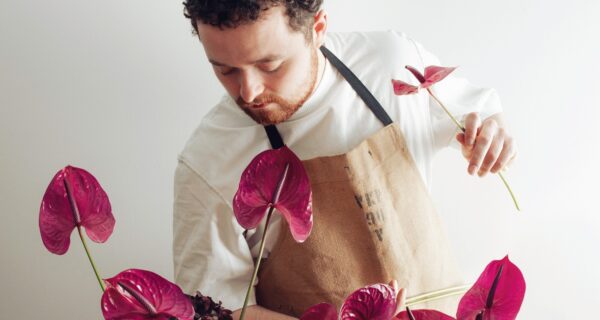
Jules Hefferon
Which course did you study at Tallulah Rose and when?
I studied the 2 Week Career Change course in November 2023 at Levens Hall, being taught modern and liberated floristry in a beautiful setting made it greatly memorable. I thought I was simply learning a trade, but what I gained was infinitely more than that.
What did you most enjoy about the course?
I came from a traditional floristry background, with rules that never asked to be questioned, often finding myself cornered by closed minded expectations of what floristry could be. The course at Tallulah Rose opened a world that felt alive with possibility. Surrounded by classmates who shared that vision, and guided by Rachel’s supportive tuition I began to see what floristry could be when you let it breathe.
What has been your career highlight so far?
A career highlight came this summer, when I supplied bouquets for the university graduations. A hundred a day, for 5 days straight. It was a blur of colour and movement. I hadn’t thought I was capable of that kind of scale, but instead, it steadied me. The work demanded focus, faith in the system I’d built. By the end, I understood what it meant to trust my own eye.
What types of arrangements do you enjoy creating the most?
The influence of Ikebana is always in my work, though I think what draws me most is its stillness, the space around the flowers as much as the flowers themselves. I’ve started using man-made materials to build sculptures that feel closer to fine art than floristry, more like a conversation with space.
What is the best piece of advice Rachel gave you?
Rachel taught me to trust my vision, to trust my eye. Not everyone will see what you see. The danger is in trying to please everyone. There’s a steadiness that comes with this, it’s what’s kept me visible in a field that can blur everyone together.
What would you say makes your floristry unique?
I often think outside of tradition and the expected. It’s the only way to see new possibilities in arranging flowers. In colleges and shops, floristry is taught as a commercial exercise, precise and predictable. That has its value, of course, but it leaves little room for experimentation, little room for the industry to move forward.
Is there an opportunity that springs to mind that Tallulah Rose gave you the confidence to pursue?
Going to Tallulah connected me to other florists in a way I hadn’t expected. It gave me the confidence to reach out, to work with people I might not have approached otherwise. The common ground we shared opened doors to opportunities I hadn’t imagined.
What impact has freelancing had on your floristry career?
Freelancing shaped me. I met people who challenged the way I saw flowers, worked in spaces that demanded flexibility, and absorbed methods I could fold into my own. It wasn’t experience alone that mattered, but showing up, paying attention, and letting each job leave a mark. The work teaches you, in ways you can’t always anticipate.
What is your favourite British flower and why?
Ammi majus is a quiet presence, it has the look of something half-remembered. Its stems rise with a kind of nervous precision, each drawing a line upward, before breaking into an eruption of white. There’s something architectural, the way the structure reveals itself through restraint. An installation using only Ammi would completely transform a space, calling attention to its elegant simplicity.
Click here to find out more about Floryn Flowers
